

Particle board and plywood are two of the most commonly compared engineered wood products in Australia, yet they are fundamentally different in composition, strength, and suitability as mezzanine floor finishes. Whether you are building a new mezzanine for storage, office space, or heavy-duty warehouse operations, choosing the wrong flooring material can result in premature failure, wasted budget, or a floor that does not meet load and operational requirements.
This guide provides a direct, detailed comparison of particle board vs plywood across the factors that matter most for mezzanine flooring: structural strength, moisture performance, cost, and real-world application suitability.
Key Takeaways
- Particle board is significantly cheaper than plywood, delivering a smooth, flat surface ideal for mezzanine floors used for general storage, office fit-outs, and light-duty applications where budget efficiency matters most.
- Plywood is structurally stronger and more moisture-resistant, making it the better choice for mezzanine floors subject to high point loads from pallet jacks, heavy shelving systems, or environments with humidity exposure.
- Neither material is universally superior. Dynamic Warehouse Solutions offers both Structaflor® particle board and F11 structural plywood as standard mezzanine floor finish options, because the right choice depends entirely on how the floor will be used.
What Is Particle Board?
Particle board, also known as chipboard, is an engineered wood panel made by compressing wood chips, sawmill shavings, and sawdust together with a synthetic resin binder under heat and pressure. The result is a dense, uniform panel with a smooth, flat surface on both sides.
As a mezzanine floor finish, particle board (specifically Structaflor®) is well suited to general storage and office environments. Dynamic Warehouse Solutions stocks Structaflor® particle board in 19mm, 22mm, and 25mm thicknesses, making it a readily available and cost-effective flooring option for mezzanine projects across Australia.
What Is Plywood?
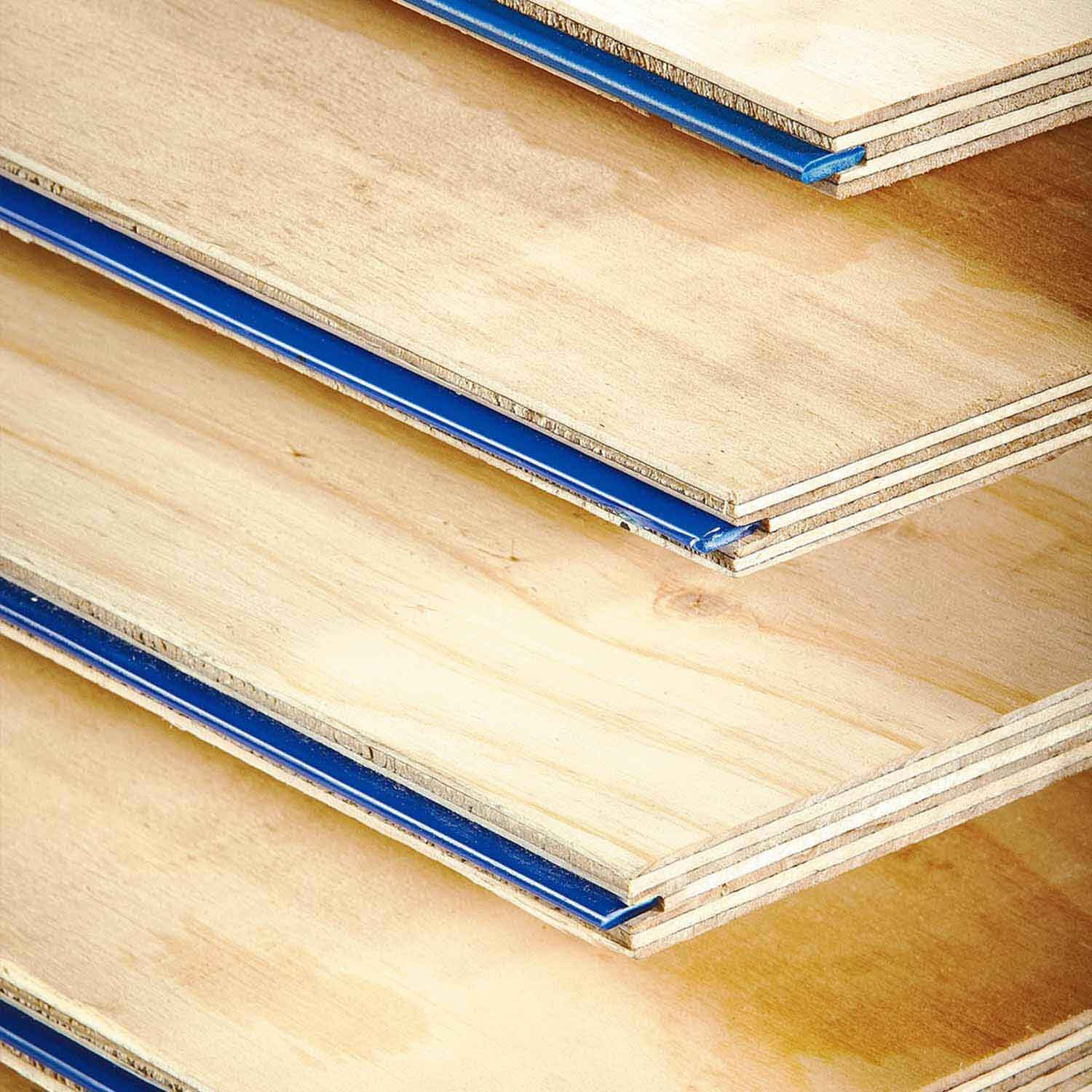
Plywood is manufactured by gluing together thin layers (veneers) of real wood, with each layer’s grain direction rotated at right angles to the one below it. This cross-laminated structure gives plywood its characteristic strength and resistance to splitting. For mezzanine flooring, F11 structural-grade plywood is the standard specification, offering superior load-bearing performance compared to appearance-grade or general-purpose sheets. The manufacturing process for plywood is more complex and material-intensive than particle board: sourcing quality veneer logs, peeling them into thin sheets, grading each layer, and bonding them under high pressure with waterproof adhesives all contribute to a higher unit cost.
Head-to-Head Comparison
Strength and Load Distribution
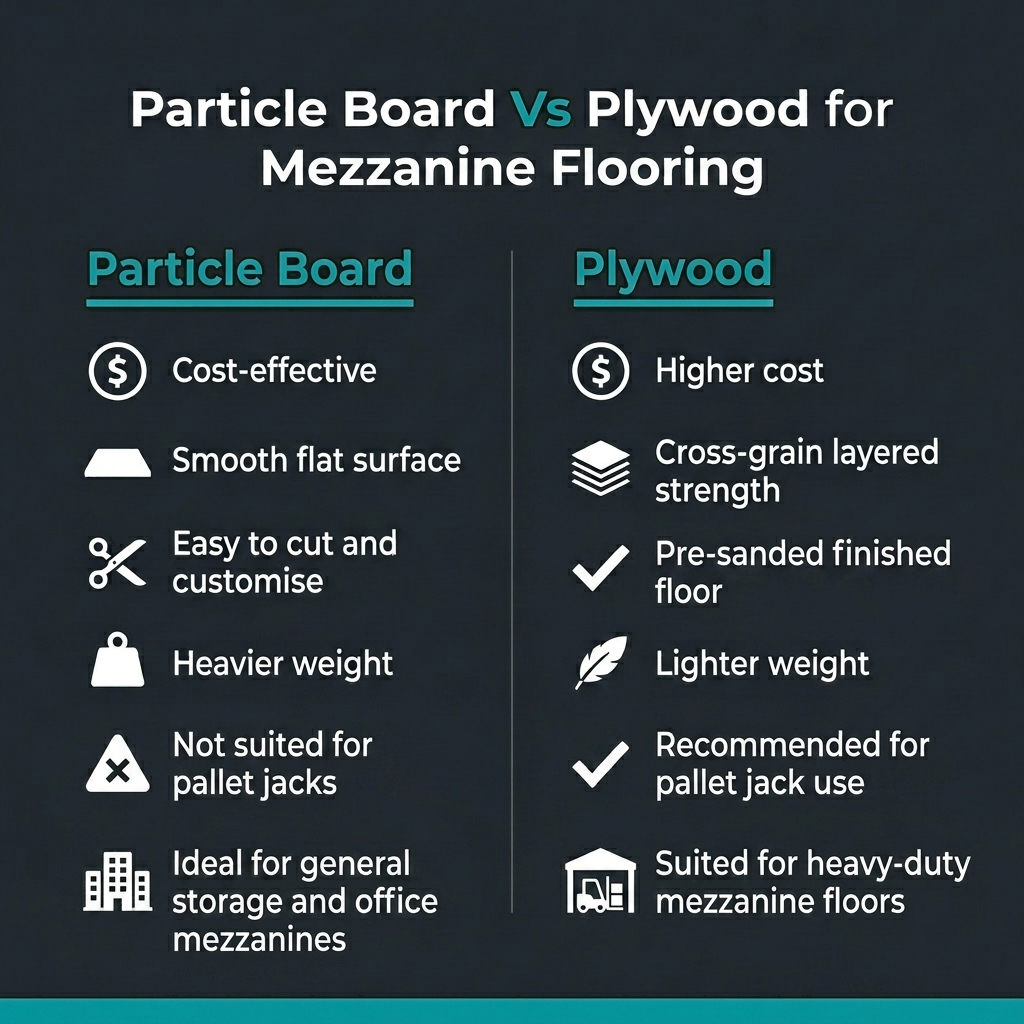
Plywood’s cross-grain construction gives it superior tensile and bending strength compared to particle board. For mezzanine flooring, this distinction is critical when the floor will be subject to concentrated point loads, such as those generated by pallet jacks, mobile shelving units, or heavy racking systems. F11 structural plywood is specifically recommended for these high-demand applications because it resists deflection under rolling and dynamic loads.
However, for mezzanine floors used primarily for general storage or office space, where loads are more evenly distributed across the surface, particle board performs exceptionally well. Its dense, uniform composition distributes weight evenly, making it an ideal floor finish for mezzanines supporting boxed goods, furniture, or static inventory. Dynamic Warehouse Solutions offers both flooring options and can advise on the right specification based on your operational requirements and load ratings.
Moisture Resistance
This is one of the most frequently asked questions about particle board. Standard particle board can swell and degrade when exposed to prolonged moisture. However, this concern is often overstated for indoor mezzanine applications.
Modern industrial-grade particle board, such as Structaflor®, is manufactured with moisture-resistant (MR) resin binders, significantly improving its durability in controlled environments such as warehouses, offices, and retail spaces. For any mezzanine application where the floor will be exposed to weather, wash-down areas, or standing water, plywood, particularly marine-grade or exterior-rated plywood, is the clear winner.
Cost and Value
For most mezzanine projects, particularly large warehouse installations, particle board is substantially more cost-effective than plywood. The savings become significant when flooring large mezzanine areas spanning hundreds of square metres across a facility.
Particle board is also easier and cheaper to cut and customise on-site. Standard tools can shape it to fit around columns, stairwells, or non-standard floor layouts without requiring specialist fabrication. For businesses fitting out a new mezzanine floor on a tight budget, particle board delivers excellent value without compromising on performance for light-duty and general storage use cases.
Surface Quality and Finish
Particle board provides a smoother, flatter surface than most plywood grades. In a mezzanine context, this makes it the preferred substrate for office areas where carpet tiles will be laid over the top, a common fit-out approach for mezzanine offices. The smooth surface also allows bins, boxes, and inventory to slide freely across the floor, improving picking efficiency on storage mezzanines.
Plywood surfaces can be uneven due to the grain pattern of the face veneer, and lower grades often feature knots, patches, or voids that may require sanding or filling before finishing. However, F11 structural plywood comes pre-sanded, providing a finished floor surface that does not require additional overlay, which can offset some of its higher material cost through reduced installation time.
Weight
Particle board is generally heavier than plywood of the same thickness. For mezzanine flooring, this is not typically a limiting factor, as the panels are fully supported by the steel floor structure beneath. However, the lighter weight of plywood can make handling and installation slightly easier, particularly when panels need to be carried up to the mezzanine level during construction.
Comparison Summary
| Feature | Particle Board (Structaflor®) | Plywood (F11 Structural) |
|---|---|---|
| Composition | Compressed wood chips and resin | Cross-laminated wood veneers |
| Strength | Good for evenly distributed loads | Superior bending, tensile, and point-load strength |
| Moisture Resistance | Low (standard) to moderate (MR grade) | Moderate to high (exterior grades) |
| Surface Quality | Smooth, flat, uniform | Pre-sanded; variable on lower grades |
| Cost | Significantly lower | Higher material and fabrication cost |
| Customisation | Easy to cut on-site | Can splinter; requires sharper tooling |
| Weight | Heavier | Lighter |
| Pallet Jack Suitability | Not recommended | Recommended |
| Best For | General storage, office mezzanines | Heavy-duty storage, pallet jack traffic |
Where Does MDF Fit In?
When comparing particle board vs MDF vs plywood, MDF (Medium Density Fibreboard) sits between the two. It offers an extremely smooth surface ideal for painted cabinetry and decorative applications, but it is the heaviest of the three and lacks the structural strength of plywood. MDF also absorbs moisture more readily than particle board, making it poorly suited for mezzanine flooring or any industrial environment.
For mezzanine floor finishes, the practical choice is between particle board and plywood. MDF is not a viable option for this application.
Addressing Common Misconceptions
“Particle board falls apart easily.” This is a misconception rooted in experience with low-grade, consumer-quality chipboard. Industrial-grade particle board, such as Structaflor® used in mezzanine flooring, is manufactured to rigorous density and bonding standards and is designed to support heavy loads over extended periods.
“Plywood is always the better choice.” While plywood excels in high-point-load and moisture-exposed applications, it is significantly more expensive and offers no meaningful advantage over particle board for mezzanine floors used for general storage or office space in a controlled indoor environment.
“Particle board cannot handle heavy loads.” On the contrary, when fully supported across its span by the steel floor structure, industrial particle board can handle substantial uniformly distributed loads. Dynamic Warehouse Solutions engineers its mezzanine floors to meet load ratings including office and general storage at 3kPa (300kg/m²), heavy storage at 5kPa (500kg/m²), or custom configurations up to 1000kg/m².
Which Floor Finish Should You Choose?
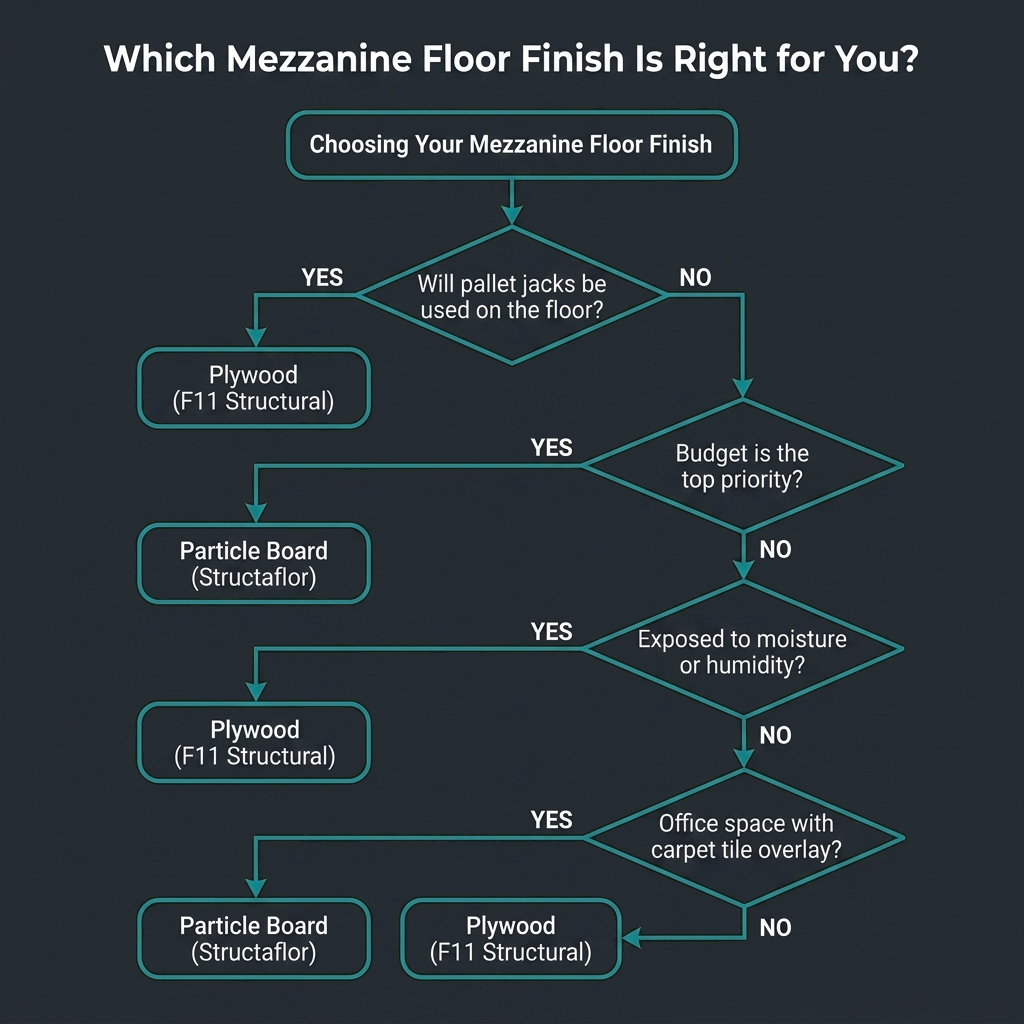
For most mezzanine projects in controlled indoor environments, particle board (Structaflor®) is the more practical and cost-effective choice. It delivers a smooth, flat surface that is easy to install, simple to customise on-site, and well suited to general storage and office applications where loads are evenly distributed. If budget efficiency is a priority and the floor will not be subject to pallet jack traffic or concentrated point loads, particle board is the clear winner.
Plywood (F11 structural) is the right choice when the mezzanine floor will support heavy rolling loads from pallet jacks, dense shelving systems, or other equipment that generates concentrated pressure points. It is also the better option for environments with higher humidity or moisture exposure, and its lighter weight can simplify handling during installation. The higher upfront cost is justified by its superior strength and durability in demanding applications.
Mezzanine Flooring Solutions from Dynamic Warehouse Solutions
If you are building or upgrading a mezzanine floor, Dynamic Warehouse Solutions can design a compliant, high-performance flooring system tailored to your specific operational requirements. Specialising in custom mezzanine design, the team supplies both Structaflor® particle board and F11 structural plywood as standard floor finish options, ensuring the right material is specified for every project.
For projects requiring structural mezzanines or raised storage platforms, Dynamic Warehouse Solutions offers a 25-year structural warranty. Mezzanine structures can be engineered to meet standard load ratings, with a minimum headroom clearance of 2100mm both above and below the deck. Allowing for a structure depth of 250mm or greater, this requires a total roof height of at least 4450mm, though a minimum of 4700mm is typically recommended for storage-only mezzanines. Learn more about the full build process.
Mezzanine systems are freestanding and structurally independent of your building’s walls and columns, securely bolted to the concrete slab. This means no load is transferred to the existing building structure, and the mezzanine can be relocated or reconfigured if your operational needs change.
The installation process is designed for minimal disruption:
- Site Consultation: A free site visit is recommended to assess workflows, clearances, and specific load requirements.
- Proposal and Quotation: A custom mezzanine layout and structural quote is drafted based on the site assessment, along with any dimensions, sketches, drawings, or photos you provide.
- Final Inspection: A mandatory on-site inspection is conducted prior to fabrication to verify all final dimensions, ensuring a precise fit.
With Hi-Span modular systems available on a lead time of 5 to 6 weeks and experienced installation crews capable of installing 50 to 100m² per day, Dynamic Warehouse Solutions can rapidly transform your warehouse footprint.
Contact the warehouse design team today to receive a tailored layout proposal and structural quotation.